
When your car picks up bodywork damage, working out what kind of repair it needs is not always straightforward. Dents can range from a soft door ding picked up in a supermarket car park to sharp creases and heavy impact damage from an accident.
Drivers often ask us whether a dent can simply be pulled out, whether it calls for traditional panel beating, or whether the panel has to be replaced altogether. The right repair route depends on the depth and shape of the dent, whether the paint has broken, where the damage sits on the panel, and what the panel is made of. Here is a clear guide to how dent removal compares with panel beating, and how our workshop team in Mullingar works out the best next step for your vehicle.
What is dent removal?
Dent removal is a broad term that covers different ways of restoring the shape of a damaged panel. In everyday workshop language, it usually refers to repairing minor, localised depressions where the metal has not been severely stretched and the original factory paint is still intact.
One specific approach within this category is Paintless Dent Repair (PDR). Where a dent is accessible from behind and the paint surface has suffered no cracking or flaking, specialised hand tools can sometimes be used to gently massage the metal back to its original contour. Because this approach preserves the factory paintwork, it avoids the need for fillers, primers, and panel respraying.
When might paintless dent repair be suitable?
Paintless repairs are most effective on shallow, soft-edged dents, such as light door knocks, hail impacts, or low-speed car park dings where the paint surface remains undamaged. However, not every small dent is a candidate. If the metal has stretched past its elastic limit, if there is a sharp crease across a body line, or if internal crash structures block access to the back of the panel, paintless methods may not be possible. Whether a dent is suitable cannot always be determined visually from a distance: hands-on assessment in the workshop is often needed to check access and metal tension.
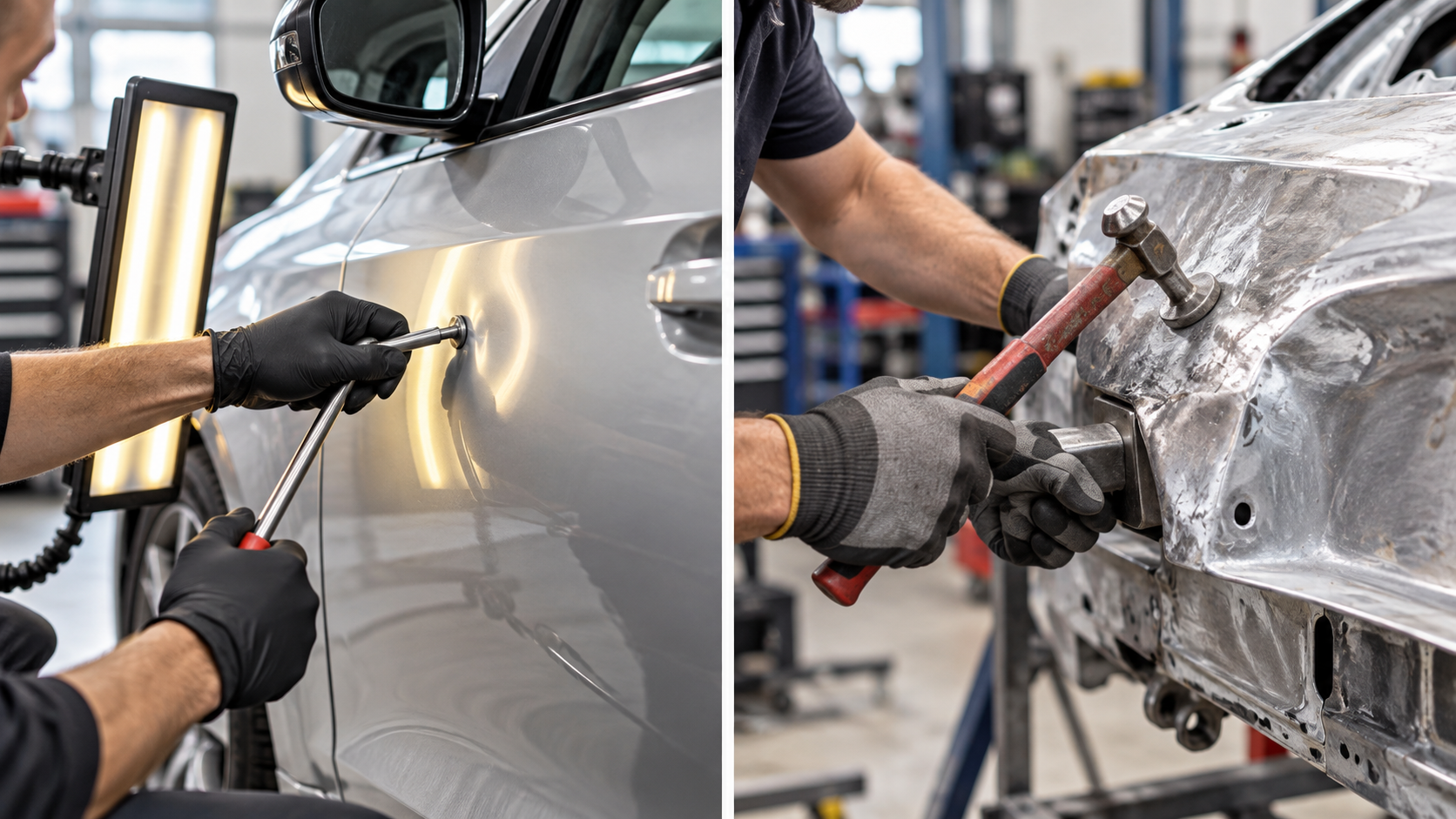
Illustrative repair guide: comparing repair methods
Note: This comparison illustration is provided to assist motorists in understanding general repair concepts. It does not depict specific workshop staff or facility equipment.
What is panel beating?
Panel beating is the traditional craft of reshaping damaged vehicle panels back to their original factory lines after an impact. It is typically used when the damage is deeper, more complex, or spread across body swage lines where simple massage techniques are not enough.
A skilled panel beater uses a combination of dollies, hammers, hydraulic pulling equipment, spot-welded stud pullers, and heat shrinking to work the distorted metal back into shape. Because working creased or sharp dents inevitably flexes and disturbs the metal surface, panel beating is almost always followed by surface preparation, body filler application, priming, and a full oven-baked respray in our paint booth to match the rest of the car seamlessly.
Panel beating is not just for write-offs: it is the standard, reliable repair method for everyday scrapes, crumpled wings, bent sills, and impacts where paint has cracked or metal has creased.
Dent removal vs panel beating: key differences
To help you see how the two routes compare at a glance, here are the main practical differences:
Typical damage
Dent removal: Small, shallow dents and car park knocks where metal has not stretched.
Panel beating: Deeper dents, sharp creases, or collision damage across panels.
Paint condition
Dent removal: Paint must be fully intact with no cracking.
Panel beating: Suitable even if paint is broken, as priming and respraying are included.
Repair process
Dent removal: Manipulating the panel from behind or glue-pulling from the surface.
Panel beating: Multi-stage reshaping with hammers, dollies, pullers, filler, and booth paintwork.
Time & cost
Depends on the individual panel and extent of damage. A small, paint-intact dent generally requires less workshop time than a full reshaping and respray.
Which repair might your car need?
Every job that arrives in our Mullingar workshop is unique, but three common scenarios help illustrate how we decide on the best repair route:
Small car park dent with intact paint
Imagine another car door swung open and tapped your passenger door, leaving a shallow, round dent the size of a coin without breaking the clearcoat. If there is good access behind the door card, a less invasive dent repair may be a strong candidate. Because the paint is unbroken, preserving the factory finish is usually the first choice.
Sharp crease or scraped paint across a body line
If your wing scraped against a pillar or gatepost, leaving a deep crease where the metal has folded or the paint has scraped down to the primer, dent removal alone is not enough. The metal has to be beaten and pulled back to the correct profile, carefully filled to recreate the original body line, and resprayed to blend in with the adjoining door and bonnet. This is standard panel beating.
Significant collision or accident damage
In heavier knocks where panels are crushed, gaps around doors or the bonnet are misaligned, or inner bumper brackets are cracked, the job enters full crash repairs. Here, a full physical inspection is essential to check underlying structures, suspension geometry, and reinforcement bars before deciding whether panels can be safely beaten or need replacement.
When does a damaged panel need replacing?
While skilled panel beating can work wonders on heavily dented metal, there are clear situations where replacing the panel with a new or quality recycled unit is the safer, more sensible choice:
- Severely stretched metal: When sheet metal is stretched beyond its physical memory, it becomes paper-thin and loses its structural tension. Forcing it back into shape can leave the panel weak and prone to oil-canning (flexing in and out).
- High-strength steel and structural sections: Modern vehicles use boron and ultra-high-strength steels around pillars and sills. Manufacturer guidelines strictly prohibit heating or beating certain structural components, as it alters the metal temper and compromises passenger safety.
- Repair economics: If the hours of specialist metalwork needed to reshape a badly crumpled wing or door skin exceed the cost of fitting a genuine replacement panel, replacement is usually recommended to save on labour costs and guarantee a clean factory fit.
- Cracked or torn aluminium or plastic: Aluminium panels are far less malleable than mild steel and can crack when reworked, while severely torn plastic bumper tabs often cannot be safely plastic-welded.
Can you tell which repair is needed from photographs?
Sending us photos is the fastest way to get our initial thoughts. When you send clear photos following our three-view photo guide, our technicians can usually tell straight away whether the damage leans towards a straightforward dent removal, a localized scratch repair, or conventional panel beating.
However, it is important to understand the limits of a photo:
Not sure which repair your car needs?
Send us a few photos through our Damage Check tool and our workshop team will guide you on the next step.
What happens when you contact The Body Shop?
Getting an initial assessment from our team in Mullingar is simple and completely free of obligation. Our online Damage Check tool walks you through four straightforward stages:
- 1Vehicle type: Select whether your vehicle is a car, SUV, van, 4x4, or commercial vehicle so we know the panel scale.
- 2Damage diagnostic: Answer 5 quick questions about the panel location, whether the paint is broken, and if the car is drivable.
- 3Photographs: Upload 2 to 5 photos showing the wider context, a close-up of the damage, and an angled view.
- 4Contact details: Leave your name, phone number, and vehicle make and model so our team can follow up with clear advice.
Once received, we review the details and let you know whether the job looks like a straightforward dent repair, requires panel beating and paint, or whether popping into our workshop at Killeenerk Moyvore for a quick physical look makes the most sense.
Frequently asked questions
Can a dent be removed without repainting?
Yes, some suitable dents can be repaired without repainting if the original factory paint is completely unbroken and the metal has not been stretched too far. However, suitability depends on the depth of the dent, its position on the panel, and whether our technicians can access the back of the metal. If the paint is cracked or the crease is sharp, panel beating and repainting will be required.
Is panel beating always more expensive than dent removal?
Generally, a straightforward dent repair that avoids paintwork involves fewer labour steps and materials, which keeps costs lower. Panel beating involves skilled metalwork, primer, colour-matched paint, clearcoat, and spray booth baking, so it naturally reflects more workshop time. However, every repair is priced individually on the actual damage rather than a flat rate.
Can a creased panel be repaired?
Yes, many creased panels can be successfully repaired using traditional panel beating techniques. A skilled technician can pull and hammer the crease back into line before finishing the surface with body filler and repainting. If the crease has severely torn or stretched the metal, replacement may be the better option.
Can I send photos before bringing my car in?
Yes. Sending photos through our online Damage Check tool is the easiest way to start. It helps our team assess the visible damage, discuss likely repair routes with you, and advise whether an in-person inspection is needed before starting work.
Related Repair Services in Mullingar

The Body Shop Crash Repairs
Based at Killeenerk Moyvore, Mullingar, Co. Westmeath, our team specialises in crash repairs, panel beating, dent removal, scratch repair, and vehicle restoration. We share practical workshop advice to help Irish motorists make informed decisions about their vehicle bodywork.
More from the Advice Hub
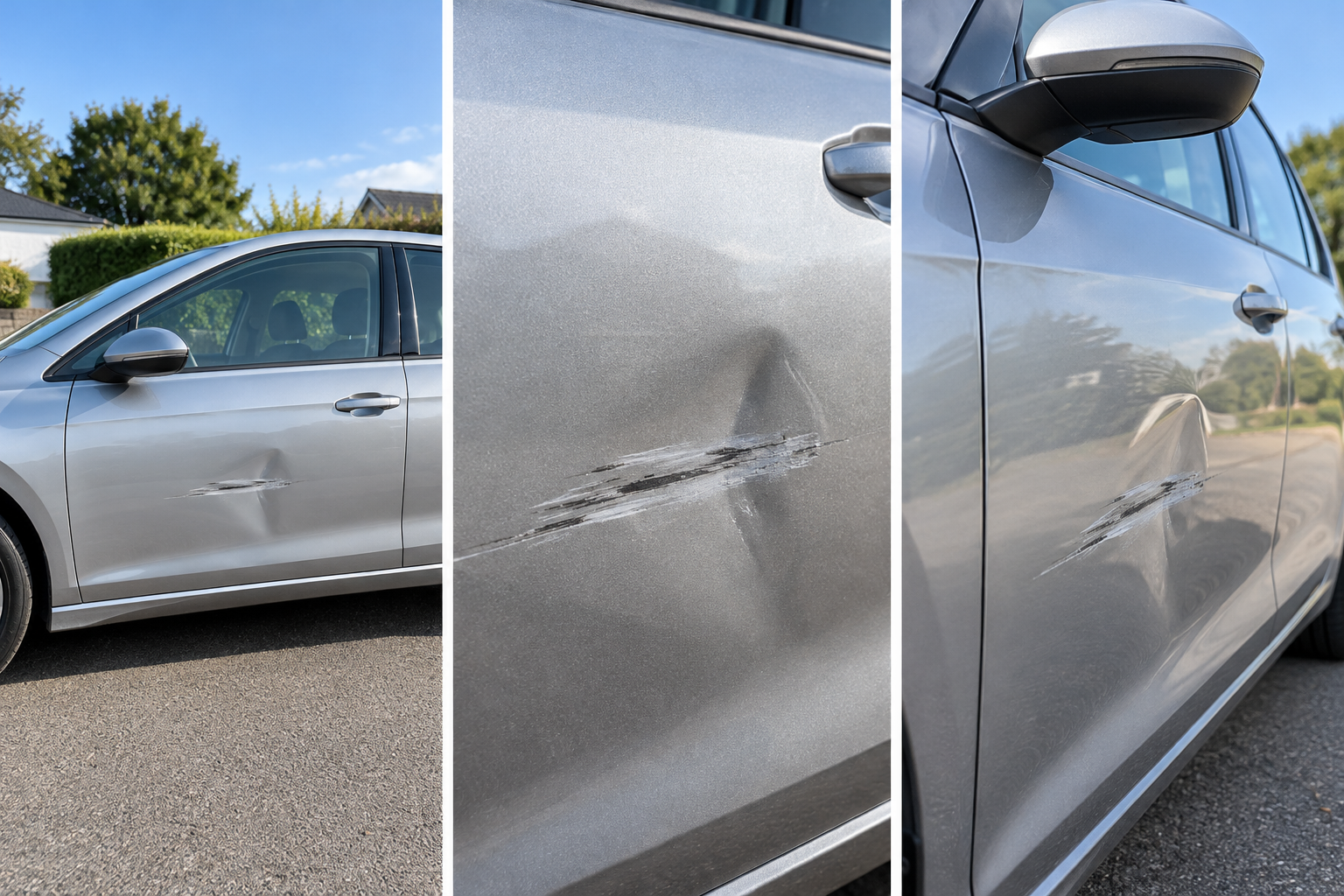 Guides
What Photos Should You Send for a Crash Repair Assessment?
Learn which photos to send for a crash repair assessment in Mullingar, including dents, scratches and panel damage. Clear photographs help us review the visible damage and advise on the next step.
Read article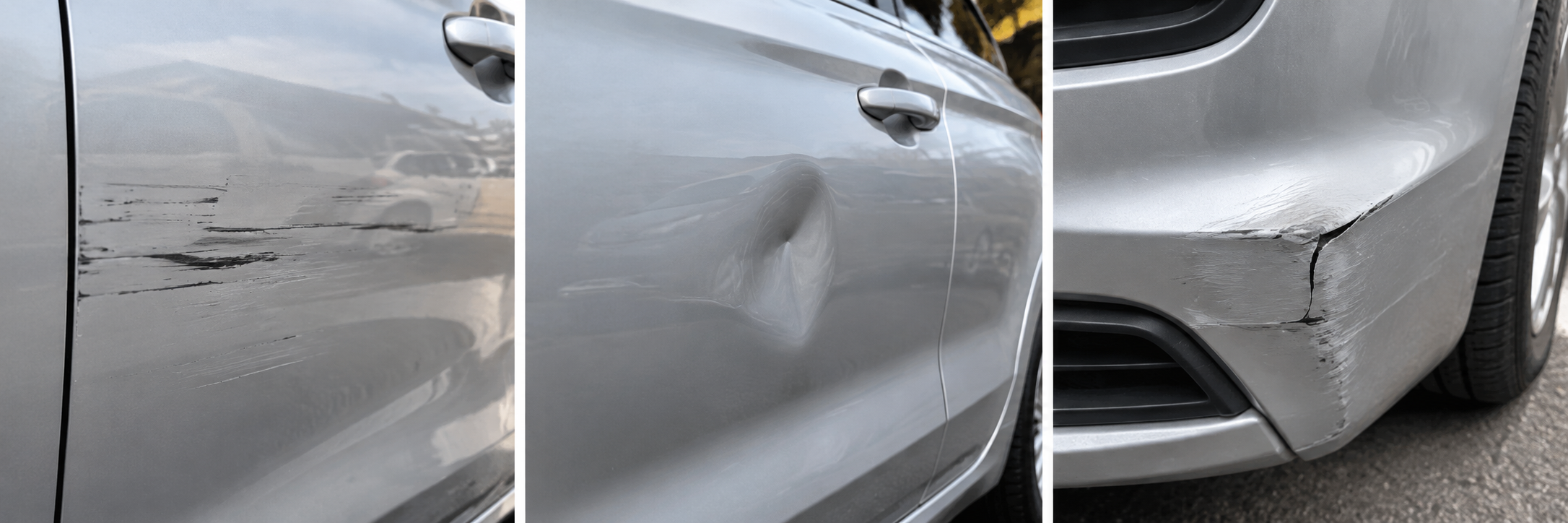 Advice
What to Do After Minor Car Park Damage
Found a dent or scratch after parking? Learn what to check, how to document car park damage, when to contact your insurer and how to arrange a repair assessment.
Read articleReady to show us the damage?
Submit clear photographs through our online Damage Check. We'll review the visible damage and help you understand the next practical step for your vehicle.